 86-0513-68903288
 13906298796@139.com
 русский
 Español
 عربى
عربىContent
Why Plant Engineers Are Moving to Oil-Free Screw Blowers
In a typical municipal wastewater plant, aeration blowers can account for more than half of the total electrical energy bill. When those blowers are oil-lubricated, maintenance teams also have to watch oil carry-over, filter changes, and contamination risks upstream of the process. Oil-free screw blowers solve both problems at once: they use synchronized rotors that never touch, and they need no oil in the compression chamber, so they deliver clean, oil-free air with a lower energy footprint than many older positive-displacement designs. The conclusion is straightforward: if your process is sensitive to oil, or the blowers run for long periods under varying load, an oil-free screw blower is usually the more economical choice over a ten-year ownership period. Specific power, the kilowatts required for every cubic meter of air delivered, is the single most useful number to compare. It tells you more than the motor nameplate, because it reflects the actual efficiency of the air end under working pressure.
That efficiency matters most when blowers run continuously. In wastewater aeration, dissolved oxygen control often requires the blower to follow a variable demand profile. An oil-free screw blower with a variable speed drive can match the load without sacrificing oil-free air quality, while an oil-injected machine has to maintain a separate oil system that increases parasitic losses.
None of this means every blower should be oil-free. A small plant with a constant flow and a very low duty cycle may be better served by a simpler rotary blower. But when running hours exceed roughly 6,000 per year, the energy savings from the screw air end often justify the higher first cost.
Oil-free versus oil-lubricated blowers: the practical differences
The table below summarizes what changes when you select an oil-free screw blower instead of an oil-lubricated design.
| Consideration | Oil-lubricated blower | Oil-free screw blower |
|---|---|---|
| Compression chamber | Oil injected for sealing, lubrication, and cooling | No oil in the compression chamber |
| Delivered air quality | Oil carry-over possible | Clean air for sensitive processes |
| Maintenance cycle | Oil and filter changes required | Fewer consumables; focus on air end inspection |
| Part-load behavior | Depends on oil system and control | Works well with VSD for variable demand |
| Failure risk | Oil contamination and high-temperature trips | Fewer oil-related failure modes |
How an Oil-Free Screw Blower Maintains Clean Compression
Oil-free screw blowers are positive-displacement machines. Two intermeshing screw rotors, usually a male rotor and a female rotor, trap air between their lobes and the surrounding housing. As the rotors turn, the trapped volume shrinks, raising the air pressure before discharge.
The air end: two rotors, no contact
The key to the oil-free principle is that the rotors do not touch each other or the housing. To maintain precise clearances, the rotors are driven by external timing gears. This means no oil is needed inside the compression chamber, and the discharge air leaves the air end free of oil aerosols. The timing gears, which sit outside the compression chamber, keep the rotor positions exact. This eliminates internal contact wear, so the only wear-related components are the bearings and gears. The trade-off is that very tight machining tolerances are required. That is why an oil-free screw blower demands a manufacturer with real air-end engineering experience, not just assembly capability. Our engineering heritage has been built on exactly that kind of precision work across blower technologies.
Moisture, temperature, and certification
Oil-free compression creates a different thermal environment than oil-injected compression. Because there is no oil to absorb heat, the air end must be properly cooled, often by a water jacket or an air-cooled design. Moisture in the suction air will also condense as the air cools, so the blower package needs reliable condensate drains and intake filtration. For processes that require documented air purity, ask for measurement according to ISO 8573-1 Class 0 or an equivalent standard; an oil-free screw blower is far more likely to meet that requirement than an oil-lubricated machine.
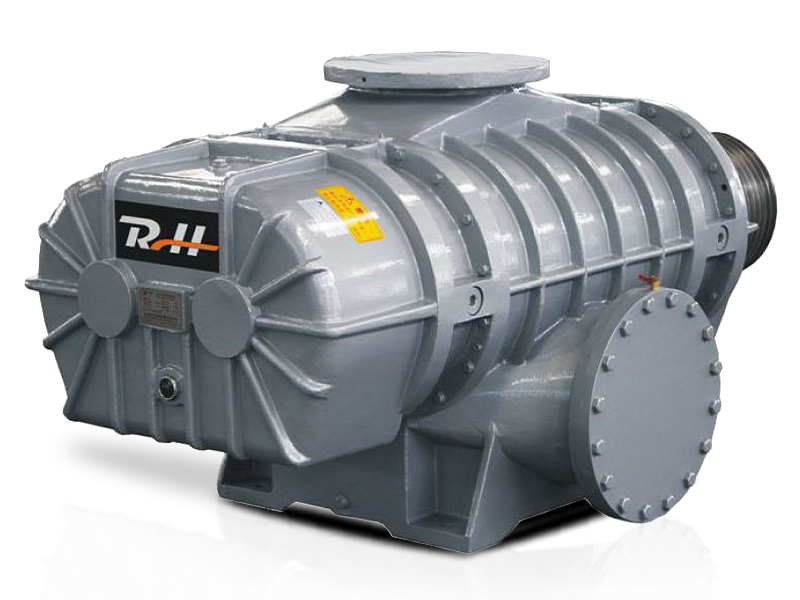
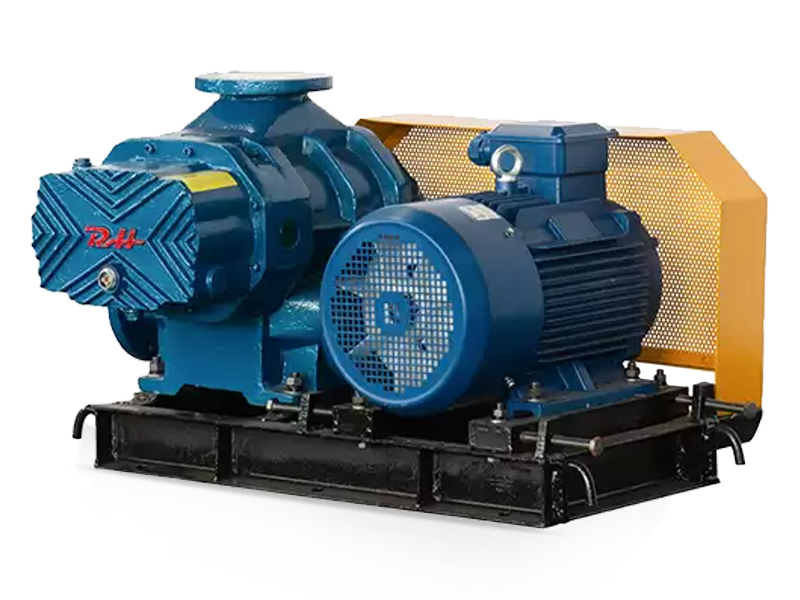
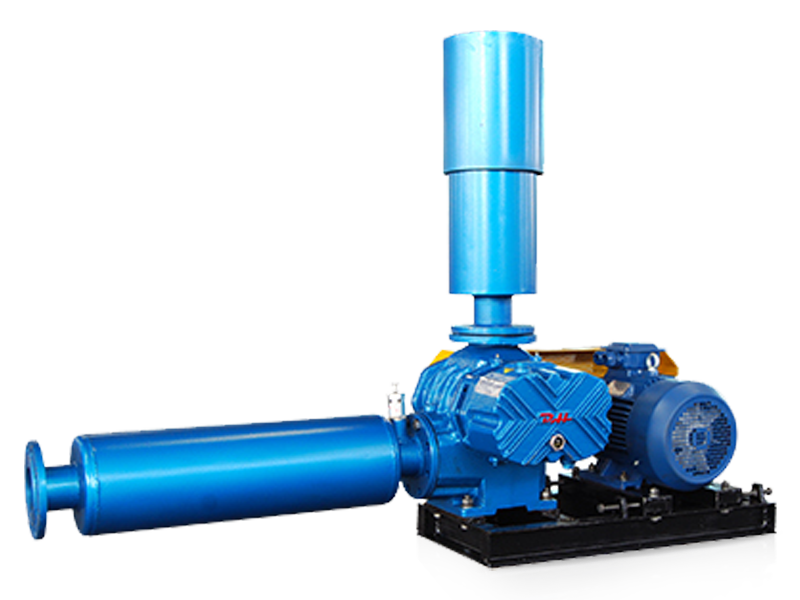
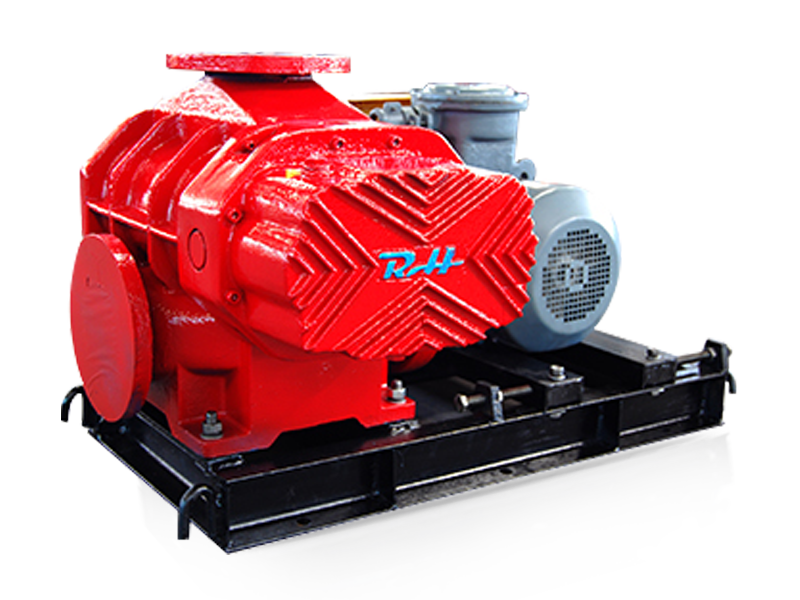
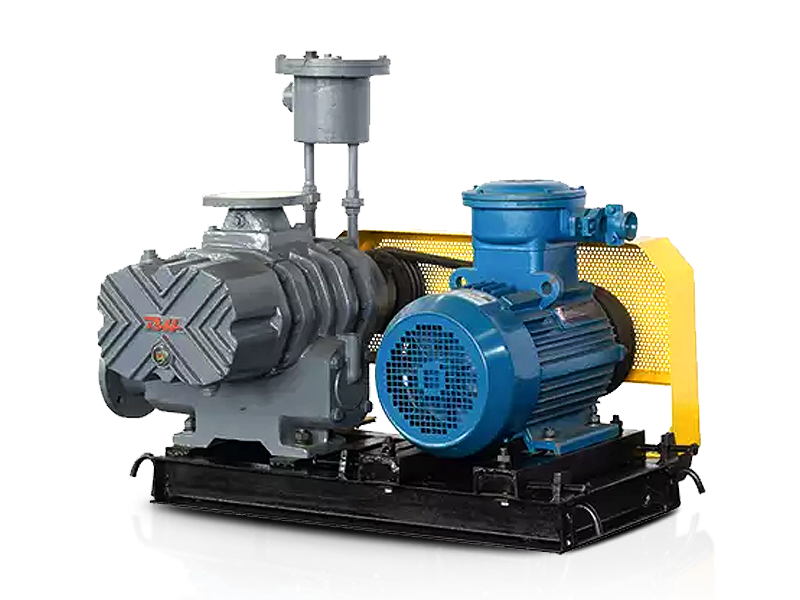
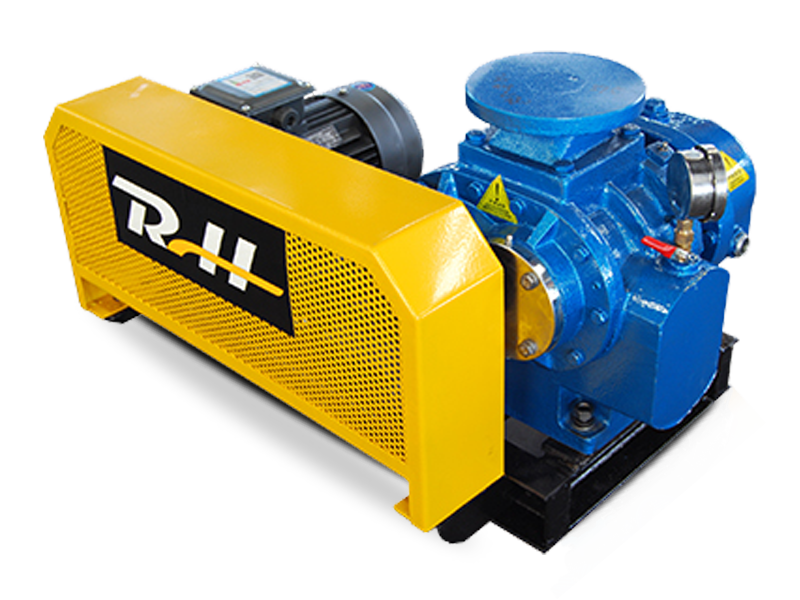
This operating principle is shared by our two oil-free screw blower families: the BSG series screw blower, designed for continuous industrial service, and the BYG series screw blower, which offers a compact configuration for space-constrained plants. Both follow the same basic approach: clean air, stable flow, and a lower maintenance burden.
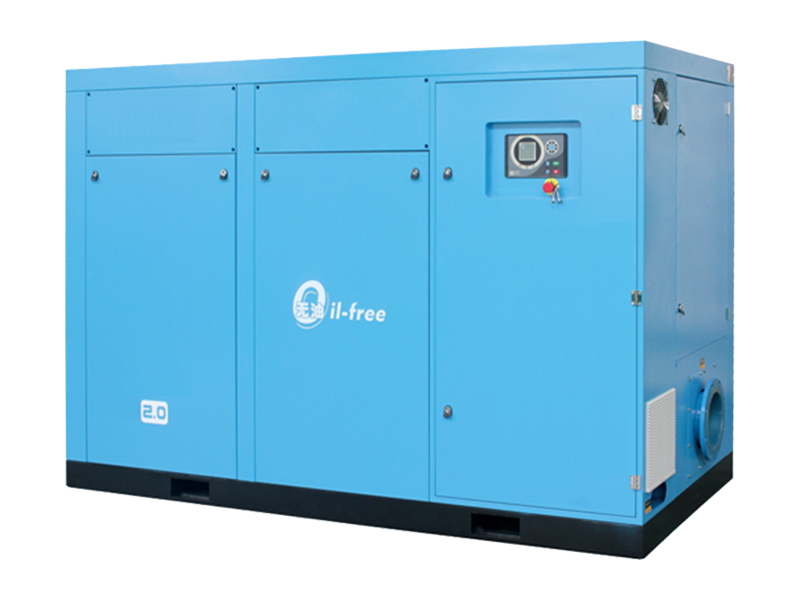 BYG series screw blower Suppliers, Company - Nantong Rongheng Environmental EquiNantong Rongheng - China Wholesale BYG series screw blower Suppliers and Company,BYG series screw blower Design And Manufacturing,View Product →
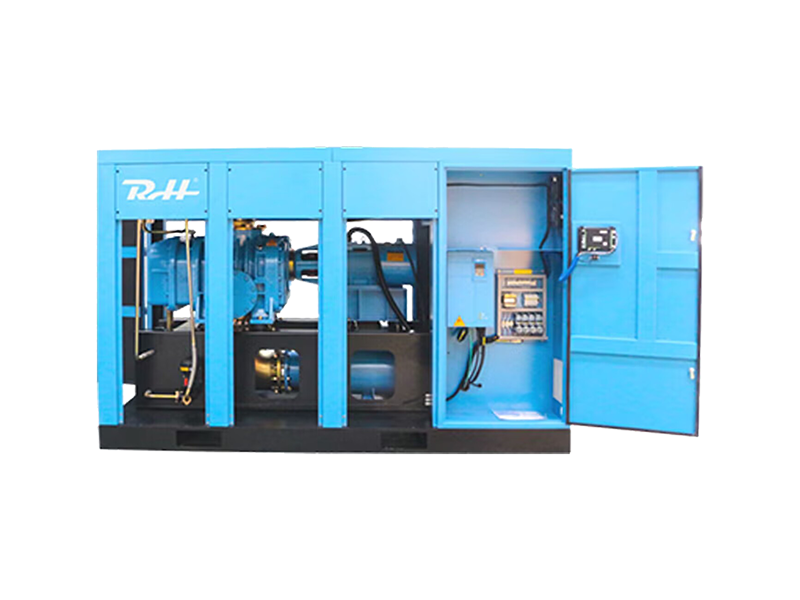 BSG series screw blower Suppliers, Company - Nantong Rongheng Environmental EquiNantong Rongheng - China Wholesale BSG series screw blower Suppliers and Company,BSG series screw blower Design And Manufacturing, Maximu...View Product →
What to Check Before You Choose an Oil-Free Screw Blower
An oil-free screw blower is a long-term investment. The most common purchasing errors are oversizing, ignoring part-load efficiency, and underestimating maintenance access. Start by defining the operating range, not just the maximum nameplate point.
Pressure, flow, and specific power
Discharge pressure should be selected at the lowest level that still gives reliable process control; every extra 0.1 bar of pressure increases the power absorbed by the blower. Flow should be based on the real demand plus a service margin, usually around 10%. Once you have a shortlist, compare specific power at the exact operating pressure you intend to use, not at a standardized test point that does not match your site.
Speed control and future load changes
A fixed-speed oil-free screw blower is a good fit for a stable base load. But if your plant already runs aeration blowers with dissolved oxygen probes, a variable speed drive is worth the additional cost. When the process load varies, the best oil-free screw blower is the one that can follow the load without cycling excessively.
Installation, ambient temperature, and packaging
Check whether the blower package includes a proper acoustic enclosure, inlet filter, and control system. If you are placing the blower outdoors, verify the allowable ambient temperature range and arrange cooling air properly. For indoor installations, leave enough clearance for air-end inspection and condensate drains. A simple site review should cover:
- Maximum and minimum flow, including seasonal peaks in wastewater plants.
- Actual discharge pressure at the point of use, not just at the blower outlet.
- Altitude and ambient temperature, because both affect air density and motor load.
- Control protocol: 4-20 mA, Modbus, or a distributed control system interface.
If you are unsure how to structure a specification, our overview of our oil-free screw blower range can give you a useful starting point.
Real-World Applications and What They Demand
Oil-free screw blowers have become a default choice in several industrial segments. Wastewater aeration is the largest market because the blowers can supply clean air for biological treatment while reducing energy use. Pneumatic conveying systems benefit from oil-free air because product contamination stops being a hidden risk. Aquaculture and water treatment plants value clean, reliable air delivery for oxygenation. Oil-free screw blowers are also used in vacuum applications when the process cannot tolerate oil vapor.
What matters in practice is performance during commissioning and after years of service. During our recent installation experience with six oil-free units, the difference between a smooth startup and a costly delay came down to clear documentation, proper piping alignment, and a control system that the plant staff could understand quickly. That is why we treat service as part of the product, not an afterthought.
If you are evaluating an oil-free screw blower for a new project or a retrofit, the right first step is to define the operating envelope and the air quality requirement. That will tell you whether an oil-free screw blower is the best choice compared with a roots blower, a rotary blower, or a turbo blower. For a process that demands oil-free air and efficient part-load performance, the answer is usually an oil-free screw blower.