 86-0513-68903288
 13906298796@139.com

 русский
 Español
 عربى
Content
- 1 The Sealing Principle Decides Everything Else
- 2 Performance: Base Pressure, Vapour and Particle Tolerance
- 3 The Cost Curve Over a Full Year of Running
- 4 Pros and Cons Side by Side
- 5 Maintenance: What the Calendar Actually Looks Like
- 6 How to Specify the Right Machine for the Duty
- 7 Frequently Asked Questions
On a paper machine or a packaging line that runs 7,000 hours a year, the vacuum pump that stops production is rarely the one with the weaker catalogue curve. It is the one whose oil was changed late, or whose oil mist reached the product. That single pattern explains most of the oil-sealed versus dry vacuum pump decision.
The comparison below covers what genuinely changes between an oil-sealed rotary vane pump and a dry running screw or roots pump: sealing principle, base pressure, vapour and particle tolerance, running cost and maintenance hours. Figures are typical ranges for industrial machines from roughly 30 to 250 cubic metres per hour, so confirm every number against the data sheet of the exact model you intend to buy.
The Sealing Principle Decides Everything Else
An oil-sealed pump uses a circulating oil film to fill the clearance between rotor, vanes and housing, while a dry pump holds a fixed mechanical clearance and seals by geometry alone.
Definition: a dry vacuum pump is a machine whose swept volume contains no sealing or lubricating liquid. The rotors never touch each other or the housing, and the oil that serves the gears and bearings sits in a separate, sealed housing outside the gas path.
Inside an oil-sealed rotary vane pump, the oil is doing four jobs at once, and each one leaves a trade-off behind:
- Sealing. The film closes the gap between vane tips and cylinder wall, which is why a simple, low-cost pump can still reach a respectable vacuum.
- Lubrication. Vanes slide against the cylinder at speed; without oil they would be worn out within days.
- Heat removal. Compression heat leaves the pump with the oil and is rejected in the oil cooler or through the housing.
- Corrosion protection. Oil coats internal surfaces, which helps on clean, dry duty and helps nothing once water or solvent reaches the sump.
Because that oil contacts the process gas directly, every solvent, acid vapour, water droplet and dust particle in the stream ends up in the sump. The symptoms are familiar to anyone who maintains these units: emulsified oil after a humid summer, sludge on a solvent duty, and a slow loss of ultimate pressure that fresh oil will not recover.
Performance: Base Pressure, Vapour and Particle Tolerance
A single-stage dry screw pump typically reaches a lower ultimate pressure than a single-stage oil-sealed rotary vane pump, but vapour and particle handling, not base pressure, decides most industrial installations.
| Criterion | Oil-sealed rotary vane | Dry screw or roots |
| Ultimate pressure, single stage | About 0.5 to 1 mbar | About 0.05 to 0.1 mbar |
| Ultimate pressure, staged | About 0.01 mbar in two-stage form | About 0.01 mbar with a roots stage |
| Water vapour tolerance | Limited; gas ballast required, oil emulsifies | High while the pump runs hot; condensate is the main risk |
| Particle tolerance | Low to moderate; dust turns the oil into sludge | Moderate; abrasive dust wears screw clearances |
| Oil backstreaming to process | Possible; exhaust filter and trap needed | None from the swept volume |
| Sound level, typical | 62 to 68 dB(A) | 72 to 80 dB(A) without an enclosure |
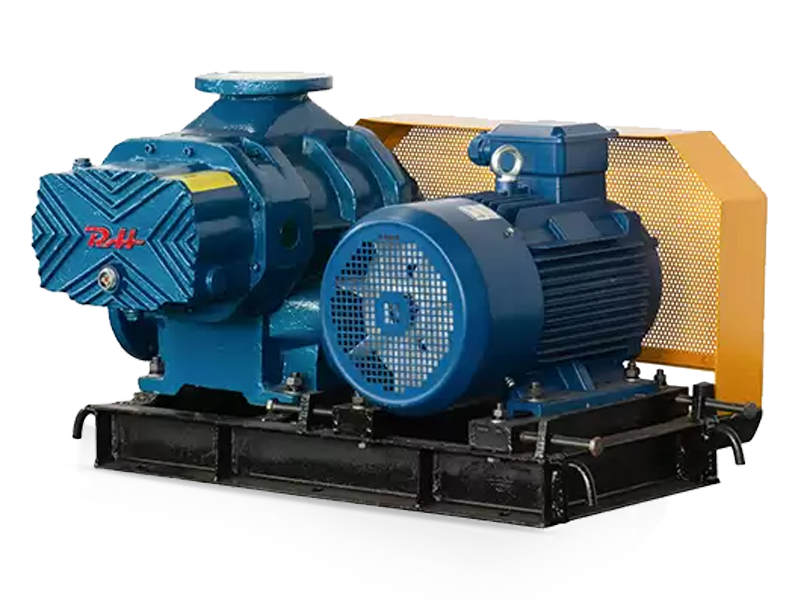
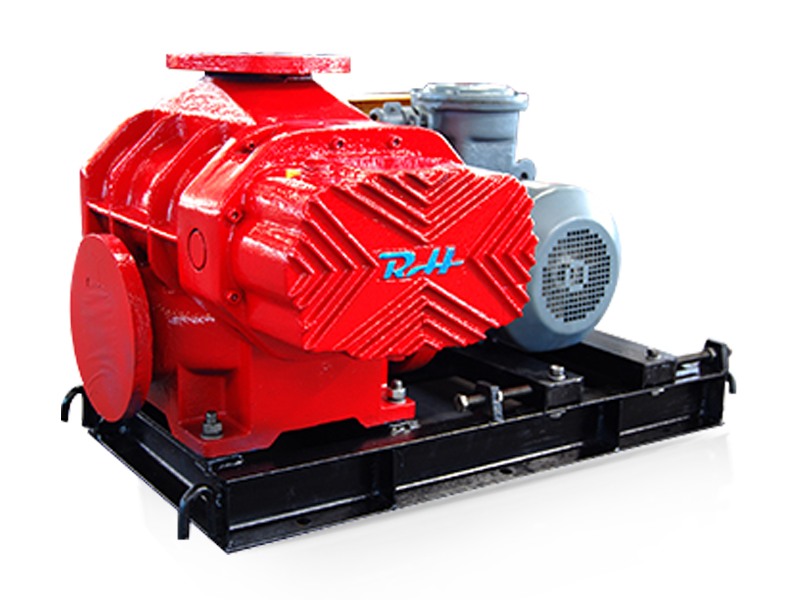
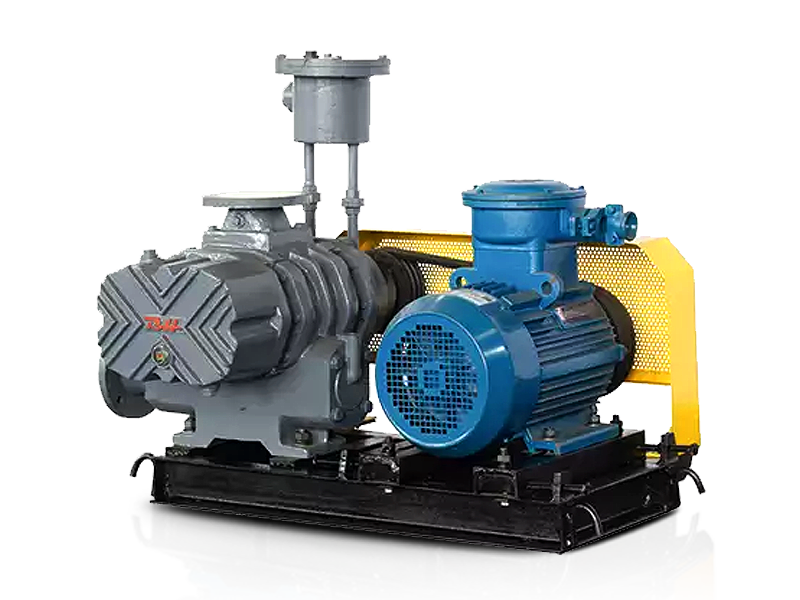
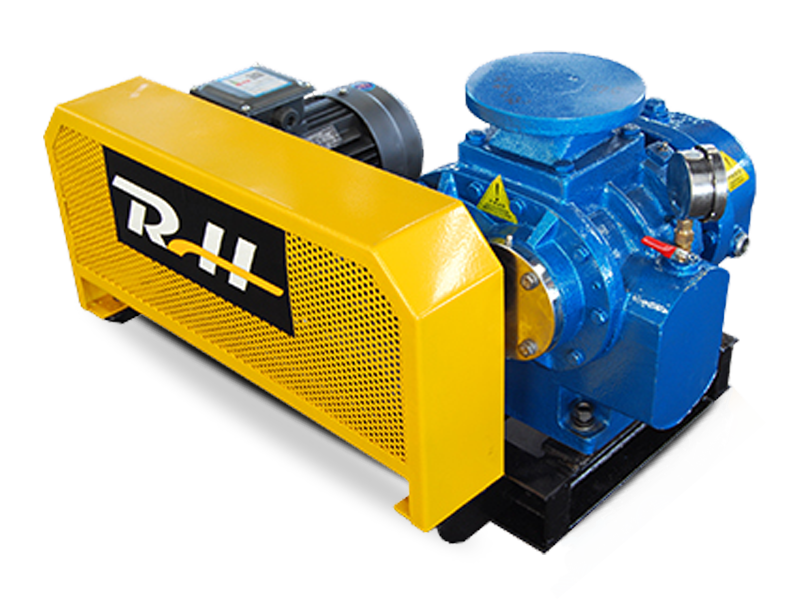
Where a process needs high throughput at coarse vacuum, such as paper machine vacuum, drying or a central vacuum system, a roots vacuum pump stage ahead of a backing pump usually buys that throughput more cheaply than a larger single machine, and it keeps the gas path oil-free.
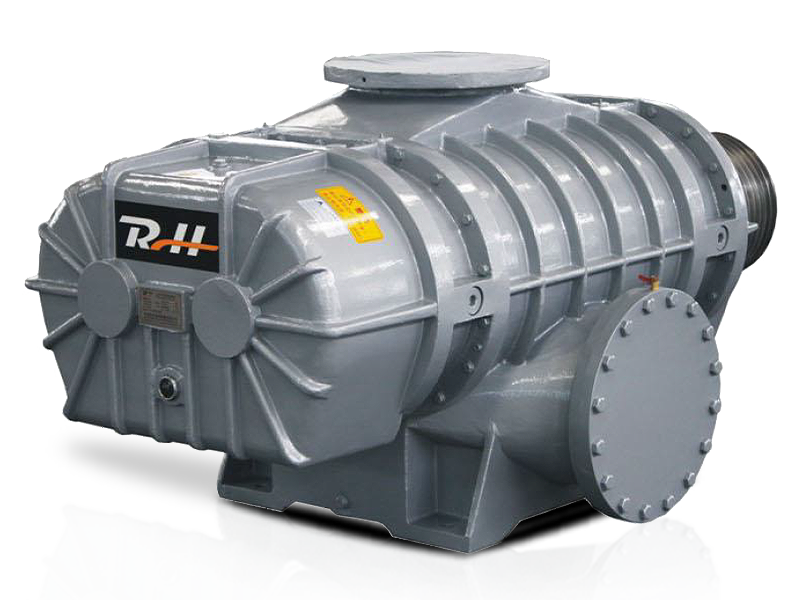 Roots Vacuum Pump for High-Throughput Coarse VacuumDry-running vacuum booster for high pumping speeds at coarse vacuum, suited to oil-free process gas paths and backing-pump combinations.View Product →
Base pressure only becomes the deciding factor in fine vacuum duty below about 1 mbar. There, a two-stage oil-sealed vane pump and a dry screw plus roots combination both perform, so the choice falls back to contamination risk and duty cycle.
The Cost Curve Over a Full Year of Running
A dry pump usually costs 1.5 to 2.5 times more to buy, while an oil-sealed pump often costs more to keep running, and the two lines typically cross somewhere between year two and year four on continuous duty.
Energy dominates that index, and the balance shifts with the working pressure. At 100 to 400 mbar in continuous operation, a dry screw machine is normally the more efficient of the two. At fine vacuum and low flow, a small oil-sealed vane pump stays competitive because it does not pay the price of heating a large dry body. Add oil purchase, filter kits and regulated disposal, and the annual gap on a heavily used pump is usually measured in hundreds rather than tens of currency units.
Pros and Cons Side by Side
Each design wins on a different axis: oil-sealed on first cost, compactness and fine vacuum at low flow, dry on cleanliness, uptime and long-run cost.
Oil-sealed strengths
- Lowest purchase price at a given pumping speed
- Compact and light, easy to retrofit into an existing skid
- Quiet enough to run without an acoustic enclosure
- Good fine vacuum in two-stage form
- Simple field repair with widely available parts
Oil-sealed limits
- Oil sits in the gas path, so backstreaming is a real risk
- Oil and filter changes plus disposal throughout the year
- Poor tolerance of water vapour and solvent vapour
- Performance falls as the oil degrades
Dry strengths
- Oil-free gas path, suitable for clean processes and solvent recovery
- Higher vapour tolerance while the pump runs hot
- Fewer consumables and no oil disposal stream
- Stable performance across long continuous runs
- Lower energy per cubic metre at coarse vacuum
Dry limits
- Higher purchase price and longer lead time
- Larger footprint and weight for the same speed
- Louder, so an enclosure is often needed
- Tight clearances are sensitive to abrasive dust, and repairs cost more
Maintenance: What the Calendar Actually Looks Like
An oil-sealed pump follows a consumable schedule, while a dry pump follows an inspection schedule; total hours are similar, but the failure modes and the downtime are not.
- 500 hours. Oil sample on a new installation, checking colour, water content and acidity to set the real change interval.
- 2,000 hours. Oil and oil filter change, gas ballast valve cleaned, inlet screen checked.
- 4,000 hours. Exhaust filter element replaced, vane wear measured, coupling alignment verified.
- 8,000 hours. Shaft seal and bearing inspection, pump body flushed if the oil showed water or solvent carry-over.
A dry screw pump normally asks for gearbox oil at 8,000 to 12,000 hours, inlet filter checks and cooling circuit attention. Its weak points are bearings, condensate collecting in the pump body when the operating temperature drops too low, and clearance wear where abrasive dust passes the inlet. Neither design is maintenance-free; the difference is that one consumes oil on a fixed rhythm while the other punishes process upsets.
How to Specify the Right Machine for the Duty
Match the pump to the gas and to the calendar, not to the headline pumping speed on the datasheet.
- List every gas in the stream before shortlisting anything: solvent vapour, acid vapour, monomer, water vapour and dust all change the answer.
- Quantify the water vapour load in kilograms per hour instead of describing the process as humid.
- State the particle load and where the filter sits, since abrasive dust is the main cause of clearance wear in dry screws.
- Count real running hours per year, weekends and cleaning cycles included.
- Confirm the working vacuum level and whether any oil carry-over could reach the product.
- Check how used oil is classified on your site, because disposal is a recurring cost rather than a one-off.
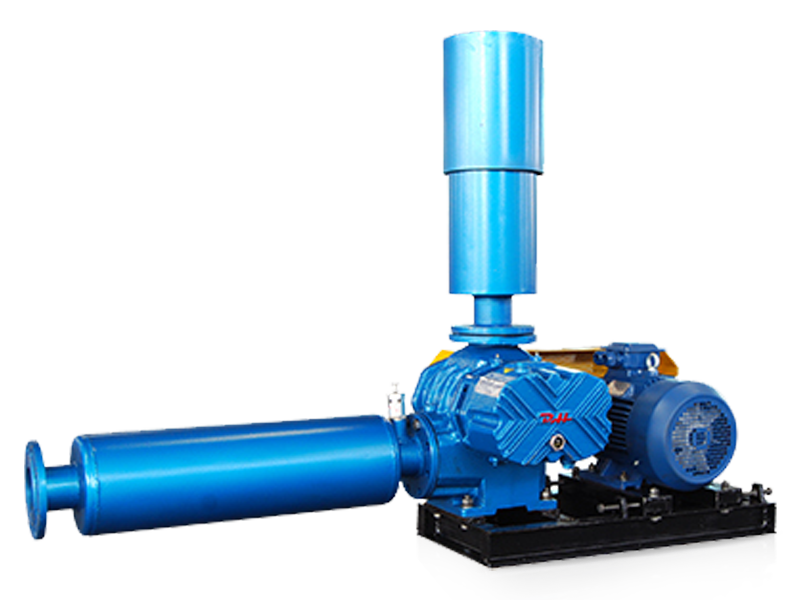
For dry running duties, a screw machine such as the BSG series is the usual starting point when the process needs a stable oil-free gas path at coarse to medium vacuum.
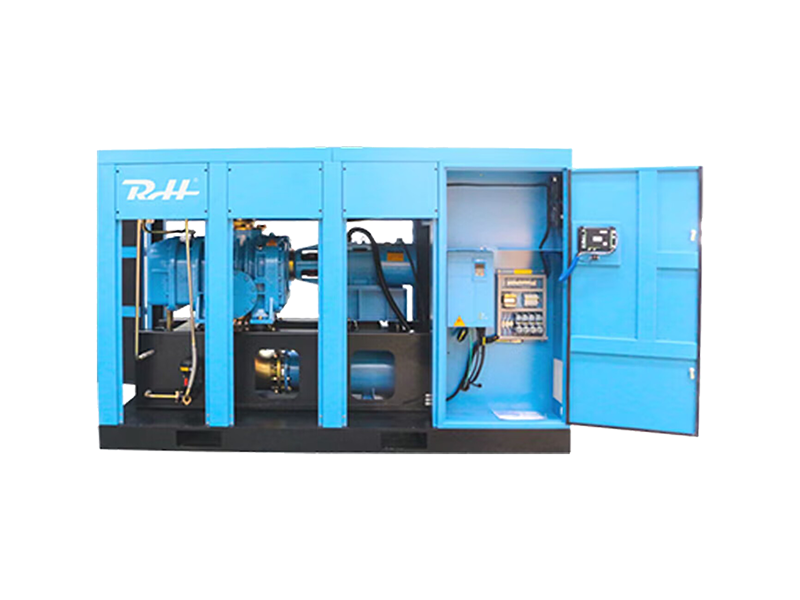 BSG Series Oil-Free Screw BlowerOil-free screw blower for dry running at coarse to medium vacuum, with simpler package and no oil-gas separator.View Product →
When the duty sits between the two technologies, our engineers can compare a roots vacuum pump arrangement against a rotary vane layout at your actual duty point, and we publish a roots vacuum pump versus rotary vane performance comparison if you want the numbers first. When you are ready, send the duty point to our team and we will size both options for you.
Frequently Asked Questions
Is a dry vacuum pump always more expensive to run?
No. A dry pump costs more to buy but usually uses less energy per cubic metre at coarse vacuum and carries no oil disposal cost, so it is normally cheaper over a five-year window above roughly 4,000 running hours a year.
Can an oil-sealed pump handle a humid process gas?
Only with the gas ballast open and a strict oil change routine. Water vapour emulsifies the oil, which drops ultimate pressure and can corrode the pump body, so above a few kilograms of vapour per hour a dry pump is the safer choice.
How often does the oil need changing?
Every 2,000 to 4,000 hours on clean, dry duty and every 1,000 to 2,000 hours on solvent or humid duty. Take an oil sample at 500 hours on a new installation to establish the real interval for your process.
Is a roots vacuum pump classed as a dry pump?
In the gas path, yes. Its two rotors are driven by timing gears and never touch each other or the housing, so no oil enters the pumped gas; the oil sits in the gearbox and bearing housings, isolated from the process.