 86-0513-68903288
 13906298796@139.com
 русский
 Español
 عربى
عربىContent
- 1 How a Centrifugal Blower Is Turned
- 2 The Role of the Impeller in Turning the Blower
- 3 Main Drive Methods Used to Turn a Centrifugal Blower
- 4 Comparing Drive Methods: A Practical Overview
- 5 How Rotation Speed Affects Blower Performance
- 6 Motor Types Commonly Used to Drive Centrifugal Blowers
- 7 Direction of Rotation and Why It Matters
- 8 Factors That Determine the Appropriate Drive Configuration
- 9 Common Issues Related to How the Blower Is Turned
How a Centrifugal Blower Is Turned
A centrifugal blower is turned by a rotating impeller that is driven by an external power source, most commonly an electric motor. The motor transfers rotational energy to the impeller either through a direct shaft coupling, a belt-and-pulley system, or a variable frequency drive (VFD). The impeller spins at speeds typically ranging from 1,000 to 3,600 RPM, drawing air in axially and expelling it radially through centrifugal force.
Understanding how the blower is turned matters because the drive method directly affects energy efficiency, speed control, maintenance requirements, and operational cost. Choosing the wrong drive configuration can reduce system efficiency by 10 to 30 percent or lead to premature component failure.
The Role of the Impeller in Turning the Blower
The impeller is the rotating core of a centrifugal blower. When it spins, it imparts velocity to the air entering through the inlet. The curved blades accelerate the air outward, converting kinetic energy into pressure as the air exits through the volute casing.
Impeller design directly influences airflow performance. Three common blade configurations are used:
- Forward-curved blades: Generate high airflow at low speeds; common in HVAC applications.
- Backward-curved blades: More efficient and self-limiting in power; preferred for industrial use.
- Radial blades: Durable and suited for high-pressure or particulate-laden airstreams.
The impeller does not turn on its own. It must be connected to a drive mechanism that delivers the necessary torque and rotational speed to meet system demands.
Main Drive Methods Used to Turn a Centrifugal Blower
There are three primary drive arrangements used in centrifugal blower systems. Each has a distinct mechanical configuration and is suited to different operating conditions.
Direct Drive
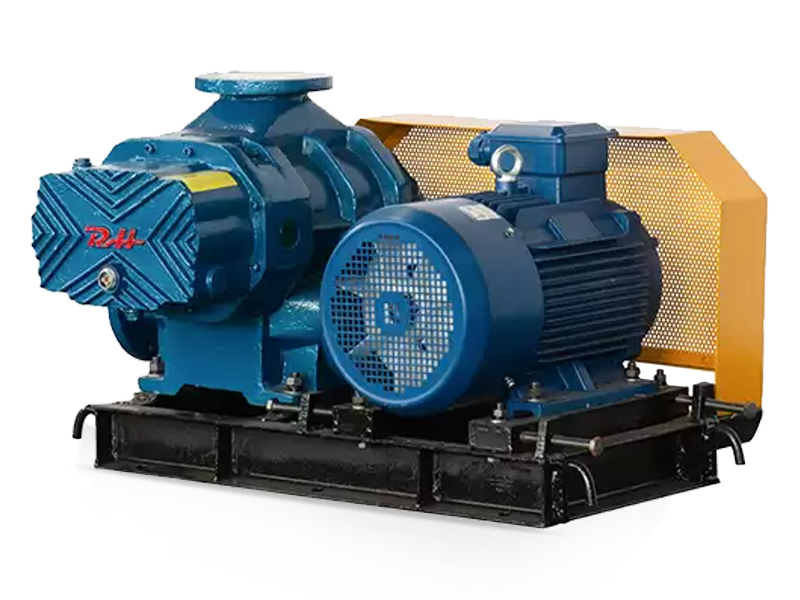
In a direct drive arrangement, the impeller is mounted directly onto the motor shaft or connected via a rigid or flexible coupling. There is no intermediary transmission element. This setup eliminates belt slip and transmission losses, making it typically 2 to 5 percent more efficient than belt-driven systems.
Direct drive blowers are compact and require less maintenance since there are no belts to replace. However, the blower speed is fixed to the motor speed, usually 1,750 or 3,450 RPM for standard induction motors. Speed adjustment requires either a different motor or a VFD.
Belt Drive
Belt drive systems use a motor pulley connected to a blower pulley via one or more V-belts or flat belts. By changing pulley diameters, operators can adjust the impeller speed without replacing the motor. This flexibility makes belt drive the most common arrangement in commercial HVAC and light industrial applications.
A typical belt drive system operates at 93 to 97 percent mechanical efficiency when properly tensioned and aligned. Belts must be inspected regularly; a worn or loose belt can drop efficiency by 5 to 10 percent and increase noise levels noticeably.
Variable Frequency Drive (VFD)
A VFD controls the AC frequency supplied to the motor, which in turn adjusts motor speed and, by extension, impeller speed. This is the most energy-efficient method for applications with variable airflow demand. Since fan power scales with the cube of speed, reducing impeller speed by 20 percent can cut energy consumption by nearly 50 percent.
VFDs are now standard in modern industrial and commercial blower installations where energy cost is a priority. They also enable soft starting, which reduces mechanical stress on the impeller and shaft bearings during startup.
Comparing Drive Methods: A Practical Overview
| Drive Type | Speed Flexibility | Typical Efficiency | Maintenance Need | Best Use Case |
|---|---|---|---|---|
| Direct Drive | Fixed (unless VFD added) | High (98-99%) | Low | Constant-load systems |
| Belt Drive | Adjustable via pulleys | Moderate (93-97%) | Moderate | HVAC, light industrial |
| VFD + Direct Drive | Fully variable | Very High (up to 97%) | Low | Variable-demand systems |
How Rotation Speed Affects Blower Performance
Centrifugal blower performance follows the fan affinity laws, a set of engineering relationships that define how changes in speed affect airflow, pressure, and power consumption.
- Airflow (CFM) changes in direct proportion to speed. Double the speed, double the airflow.
- Static pressure changes with the square of speed. Double the speed produces four times the pressure.
- Power consumption changes with the cube of speed. Double the speed requires eight times the power.
For example, a blower running at 1,800 RPM consuming 10 kW that is slowed to 1,440 RPM (80 percent of original speed) will consume only 5.12 kW, a reduction of nearly 49 percent. This is why VFDs have become the preferred control method in energy-conscious facilities.
Motor Types Commonly Used to Drive Centrifugal Blowers
The motor is the primary power source that turns the blower. The type of motor selected affects starting torque, speed range, energy efficiency, and compatibility with control systems.
AC Induction Motors
The most widely used motor type in centrifugal blower applications. AC induction motors are robust, low-cost, and available in power ratings from fractional horsepower to several hundred kilowatts. Standard models run at synchronous speeds of 1,800 or 3,600 RPM at 60 Hz. They can be paired with VFDs for speed control.
Permanent Magnet Motors
Increasingly used in high-efficiency blower systems, permanent magnet motors offer efficiency ratings above 95 percent across a wide speed range. They are more expensive upfront but reduce long-term energy costs significantly, particularly in continuous-duty applications.
EC (Electronically Commutated) Motors
Common in smaller HVAC blowers and fan coil units, EC motors integrate the control electronics directly into the motor assembly. They provide precise speed control and reach efficiencies of 85 to 92 percent at partial loads, outperforming conventional AC motors in variable-speed operation.
Direction of Rotation and Why It Matters
Centrifugal blowers are designed to rotate in a specific direction, either clockwise (CW) or counterclockwise (CCW) when viewed from the drive side. This is determined by the orientation of the impeller blades and the shape of the volute casing.
Running a blower in the wrong direction causes the impeller to push air against the intended airflow path. In many cases, this does not immediately damage the blower but results in severely reduced airflow, often less than 50 percent of rated capacity, along with unusual noise and vibration.
To verify correct rotation on a three-phase motor installation, a brief bump test is performed: the motor is energized momentarily and the shaft rotation is visually confirmed against the direction arrow marked on the blower housing. If rotation is reversed, any two of the three power leads are swapped to correct it.
Factors That Determine the Appropriate Drive Configuration
Selecting the correct drive method involves evaluating several operational and economic factors:
- Airflow variability: Systems with fluctuating demand benefit most from VFD control. Constant-volume systems can use simpler direct or belt drives.
- Operating hours: Blowers running more than 4,000 hours per year justify the higher upfront cost of VFDs through energy savings.
- Speed requirements: If the required impeller speed differs significantly from standard motor speeds, belt drive offers simple adjustment without custom motor sourcing.
- Space constraints: Direct drive systems are more compact and eliminate the need for belt guard assemblies.
- Maintenance capacity: Facilities with limited maintenance staff often prefer direct drive systems to avoid belt tensioning, alignment, and replacement tasks.
Common Issues Related to How the Blower Is Turned
Problems with the drive system are among the most frequent causes of centrifugal blower underperformance. Key issues include:
- Belt slippage: Causes speed loss and heat buildup. A properly tensioned belt should deflect approximately one inch per foot of belt span under moderate hand pressure.
- Pulley misalignment: Leads to uneven belt wear and increased bearing loads. Alignment should be checked with a straight edge or laser tool at installation and after any motor replacement.
- Bearing wear: Worn bearings increase rotational resistance and vibration. Bearing temperature above 200 degrees Fahrenheit during operation typically indicates inadequate lubrication or overloading.
- VFD harmonics: Poorly configured VFDs can introduce electrical harmonics that heat motor windings. Inverter-duty rated motors are designed to handle this and should always be specified when a VFD is used.